
Polished, Stamped, or Traditional: Which Concrete Flooring Finish Is Right for You?
By Concrete Plot
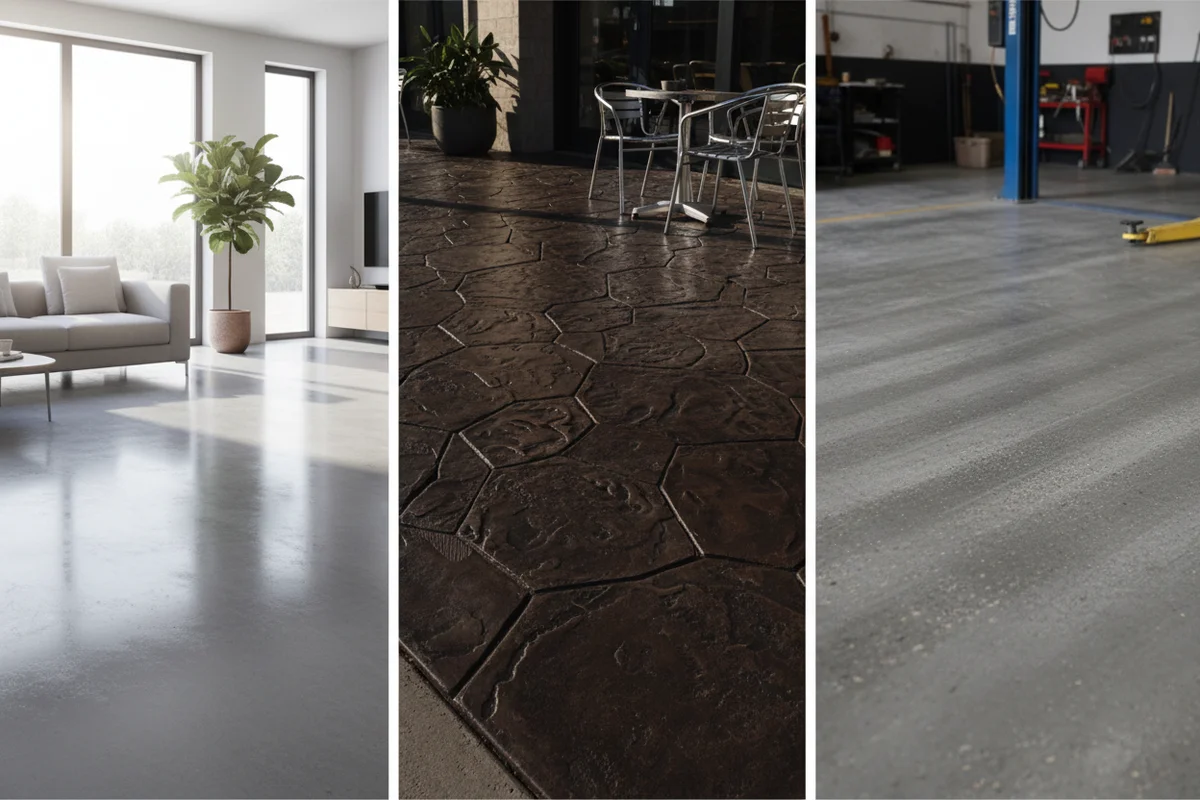
Explore the differences between polished, stamped, and traditional concrete flooring finishes to find the perfect option for your space.
Polished, Stamped, or Traditional: Which Concrete Flooring Finish Is Right for You?
Concrete flooring has moved well beyond its industrial roots and is now one of the most versatile and widely used flooring materials in both residential and commercial construction. Whether you are renovating a home, designing a retail space, or planning a new build, understanding the differences between polished concrete, stamped concrete, and traditional concrete finishes will help you make a more informed decision that balances cost, aesthetics, maintenance, and long-term durability.
What Is Polished Concrete and Who Is It Best For?
Polished concrete is achieved by mechanically grinding the surface of a concrete slab with progressively finer diamond abrasives until a smooth, reflective finish is produced. The result is a sleek, modern surface that can be customised to different levels of sheen and aggregate exposure, meaning the appearance can range from a subtle matte to a high-gloss mirror-like finish depending on the preferences of the owner or designer.
One of the most significant advantages of polished concrete is its durability and its suitability for high-traffic environments. Because the surface is densified and hardened during the polishing process, it resists wear and tear far better than many other flooring options and therefore performs particularly well in commercial settings such as retail stores, warehouses, showrooms, and office buildings. In residential settings, polished concrete works well in open-plan living areas, kitchens, and hallways where a contemporary aesthetic is desired.
From a maintenance perspective, polished concrete is one of the easiest flooring options to care for because it requires only routine cleaning with water or a neutral pH cleaner and does not need waxing or the application of surface coatings. Periodic repolishing may be necessary in very high-traffic areas, but for most residential applications the surface holds up well with minimal intervention.
The cost of polished concrete typically falls between $3 and $12 per square foot, making it one of the more affordable decorative concrete options, particularly when an existing slab is already in place. This brings us to one of its most important sustainability benefits, which is that polishing an existing concrete slab eliminates the need for additional flooring materials such as timber, carpet, or tiles and therefore reduces the overall environmental impact of a renovation or new build. Polished concrete can also contribute to LEED credits under the U.S. Green Building Council's guidelines, particularly in categories related to material reuse and indoor environmental quality.
However, polished concrete does have drawbacks that are worth considering before committing to this finish. The hardness of the surface can be uncomfortable to stand on for extended periods, which may be a concern in kitchens or workshops where people spend long hours on their feet. Polished concrete also tends to retain ambient temperature and can feel noticeably cold underfoot in cooler climates, which may require the installation of underfloor heating to maintain comfort. Additionally, the hard reflective surface can amplify noise, and natural expansion and contraction of the slab over time may lead to hairline cracks in some cases.
Stamped Concrete: Decorative Appeal at a Competitive Price
Stamped concrete involves pressing patterns and textures into freshly poured concrete before it sets, allowing the surface to mimic the appearance of materials such as brick, natural stone, slate, or even timber. This technique gives homeowners and builders access to a wide range of decorative finishes that would otherwise require significantly more expensive materials to achieve.
The aesthetic versatility of stamped concrete is one of its strongest selling points because it can be combined with integral colour pigments or surface-applied stains to create highly customised designs that complement the surrounding architecture and landscaping. This makes it a popular choice for outdoor applications such as driveways, patios, pool surrounds, and garden paths, where visual impact and weather resistance are both important considerations.
When properly sealed, stamped concrete resists weathering and wear effectively and can achieve a structural lifespan of 25 to 30 years, which is consistent with other well-maintained concrete finishes. The cost of stamped concrete typically ranges from $12 to $20 per square foot, which is higher than polished or traditional finishes but still considerably less expensive than the natural stone or brick it is designed to replicate.
The main drawback of stamped concrete is its maintenance requirements, which are more demanding than those of polished concrete. The sealant that protects the surface and enhances its colour needs to be reapplied every two to three years to maintain both the appearance and the structural integrity of the finish. If the sealant is not applied correctly or is allowed to degrade, the surface can become slippery, which is a safety concern particularly in outdoor areas exposed to rain or moisture. Repairs to stamped concrete can also be visually noticeable because matching the original pattern and colour precisely is difficult, and therefore any patching work may affect the overall aesthetic of the surface.
From a sustainability standpoint, stamped concrete still relies on the production of Portland cement, which carries a significant carbon footprint, and therefore it does not offer the same environmental advantages as polishing an existing slab. However, the fact that it can replicate the appearance of quarried stone or harvested timber without requiring those natural resources to be extracted does provide some indirect environmental benefit.
Traditional Concrete Finishes: Functional and Cost-Effective
Traditional concrete finishes include broom finishes, trowel finishes, and float finishes, all of which produce a simpler and more utilitarian surface compared to polished or stamped alternatives. These finishes are applied during or immediately after the concrete is poured and do not require the additional processing steps associated with the more decorative options.
The primary advantage of traditional finishes is their cost-effectiveness, with prices typically ranging from $4 to $8 per square foot, making them one of the most affordable flooring solutions available. Broom finishes in particular are widely used in outdoor areas such as driveways, footpaths, and garage floors because the textured surface provides enhanced traction and therefore reduces the risk of slipping in wet conditions.
Trowel finishes produce a smoother surface that is commonly used in industrial and commercial settings where a clean, flat floor is required for equipment or foot traffic. While these finishes are functional and durable, they lack the decorative appeal of polished or stamped concrete and are therefore less suitable for spaces where visual presentation is a priority.
Maintenance for traditional finishes is straightforward and involves basic cleaning along with periodic sealing every three to five years to protect against staining and surface wear. Like all concrete flooring options, traditional finishes can achieve a structural lifespan of 25 to 30 years when properly maintained, making them a reliable long-term investment despite their modest appearance.
Making the Right Choice for Your Project
Choosing between polished, stamped, and traditional concrete finishes ultimately depends on the specific requirements of your project in terms of budget, location, intended use, and aesthetic goals. Polished concrete offers the best combination of low maintenance, modern aesthetics, and sustainability for interior applications and is particularly well suited to high-traffic commercial environments or contemporary residential spaces. Stamped concrete provides exceptional decorative flexibility and is an excellent choice for outdoor areas where the appearance of premium materials is desired without the associated cost. Traditional finishes remain the most practical and affordable option for utilitarian applications where function takes priority over form.
All three options are capable of delivering a durable and long-lasting floor surface when installed correctly and maintained according to their specific requirements, and therefore any of them can represent a sound investment for homeowners and builders alike.